
Roman rule in Britain came to an end over 1,600 years ago. But, we still feel and see its impact across the British landscape. Roman control of large swathes of the UK means that there are plenty of great Roman ruins to discover. Whether you want to explore the great Hadrian’s Wall further afield or discover hidden gems (and hoards) closer to home, check out our list of the best Roman ruins in the UK
Bignor Roman Villa: Life of the Roman Elite and Impressive Mosaics
1 hour 30 minutes
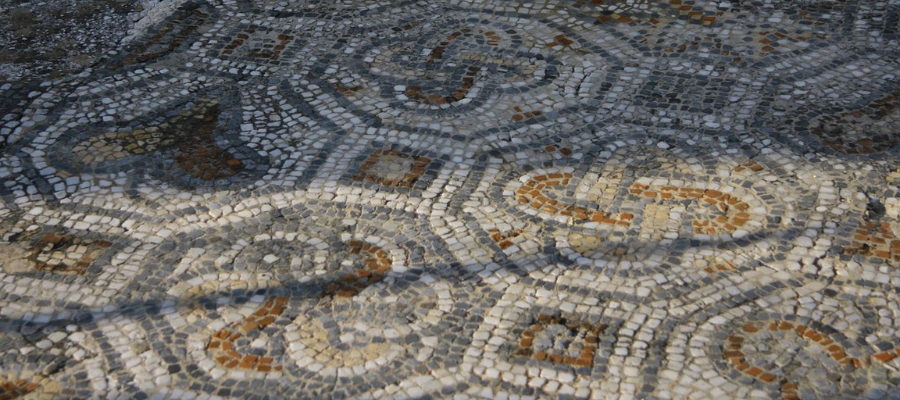
Bignor Roman Villa, built in AD 200, holds some of Britain’s most impressive and complete Roman mosaics. Roman citizens left the sprawling villa in AD 400. It wasn’t until farmer George Tupper began working the land in 1811 that the site was re-found. Striking something solid, further investigation unearthed a Roman water basin. Archaeologist soon found the ruins of a large Roman villa. The first room excavated, the Summer dining room, holds one of the notable mosaics: Ganymede carried from Mount Ida by a giant eagle. Another must-see mosaic, located just off of the bath house, depicts Medusa.
Fishbourne Palace: Sprawling Roman Residence and Stunning Mosaics
1 hour 35 minutes
Another large Roman residence is Fishbourne Palace. Dating back to AD 75, the original construction had over 100 rooms. For context, it was larger than Buckingham Palace! Though the owner remains a mystery, some historians believe it may have belonged to native chieftain of the Regni tribe, Tiberius Claudius Togidubnus. Whoever the true owner was, they had immense wealth and influence. Visitors walk along raised platforms in a permanent enclosure to safely view the incredible mosaics. Works of note include “Cupid on a Dolphin” and a Medusa motif. Fishbourne Palace owners have also recreated the outdoor landscaping in the layout of ancient Roman gardens.
Dover’s Roman Remains: Dubris’ Roman Painted House and Lighthouse
2 hours 10 minutes
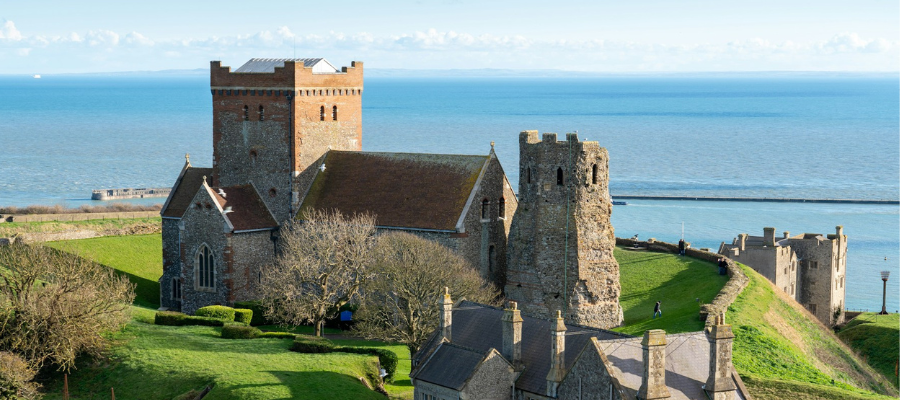
Dover was an important stronghold for trade and security. Known as Dubris, it was the closest point between Roman Britain and the rest of the Roman Empire. The small fort established early in Rome’s occupation consisted of wall fortifications and two lighthouses. Over time, the fortress grew to meet the needs of inhabitants. Two notable structures include the Painted House and the lighthouse in Dover Castle.
Roman Lighthouse
Not only is this octagonal lighthouse one of Britain’s oldest, but it is one of the world’s oldest and best-preserved lighthouses. Built around AD 50 during Emperor Claudius’ reign and invasion of Britannia, the tower would have originally stood 24 metres tall. Today it stands atop Castle Hill only 19 metres tall, but still an impressive lasting feat of Roman engineering. Its twin lighthouse would have stood on the adjacent Western Heights hill. Known as a pharos, the lighthouse would be operated by kindling a fire, guiding ships into port. After Dubris was abandoned, the medieval church of St. Mary-in-Castro was built right next to the Roman pharos several hundred years later in AD 1020. The medieval congregation used the lighthouse as a chapel and bell tower.
Roman Painted House
Dover’s position as a significant trading port and gateway to Britannia Romana necessitated the building of a mansio, or a large hotel. What is now known as the Painted House was a hotel for Channel travellers from AD 200 to AD 270. Because of the port’s growth, the painted house was eventually knocked down and buried to make way for larger fortress walls. By burying the foundations and portions of the standing wall, the building was preserved in the soil for thousands of years until it was discovered in the 1970s. What archaeologists found was five rooms with painted plaster murals, painted panels, and a largely intact hypocaust—the roman system for underfloor heating. Many of these spectacular panels depict Bacchus, the Roman god of wine, signifying this hotel was a place for good times.
Roman Baths: Aquae Sulis, Hot Springs, and Civilian Life in Roman Britain
2 hours 10 minutes
The Roman Baths in the city of Bath is a remarkably in-tact Roman bath house. Built at the beginning of Roman conquest, the town of Aquae Sulis grew up around a natural hot spring. The name translates to “the Waters of Sulis”, a dedication to the goddess of Sulis Minerva. Not only do visitors get to walk around ancient Roman bath house facilities, but the museum paints the day to day lives of British Roman citizens in vivid colour.
You’ll find artefacts of Roman writing, artistic stonework, and a greater understanding of how social life revolved around this communal space. After the museum, you will walk along raised platforms across the original stone floors that lead to where the bath house’s temple would have stood. An incredibly rare gilt bronze statue is on display, depicting the face of Minerva. The rarity of such an item indicates that Aquae Sulis was an important location in Roman Britain. No wonder this is a UNESCO World Heritage Site! Discover other UK UNESCO sites you can visit.
Wroxeter: One of Roman Britain’s Largest Cities
2 hours 40 minutes
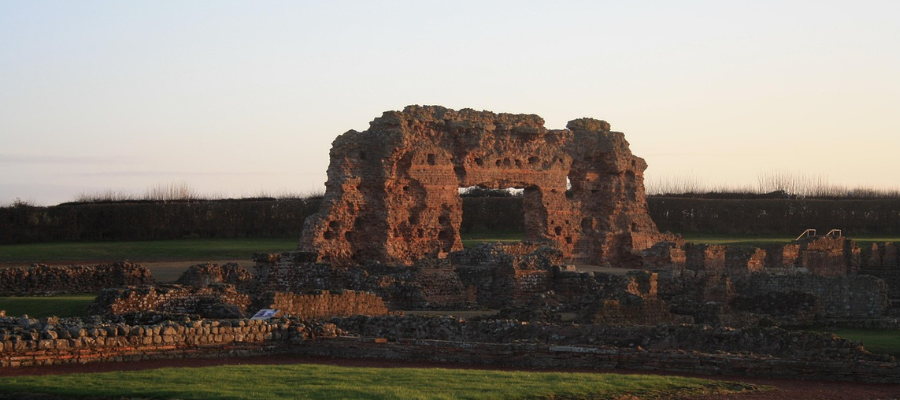
At its height, Wroxeter was one of Roman Britain’s largest cities with a population of over 15,000 people. Rome wasn’t built in a day and neither was Wroxeter, or as it was known, Viroconium Cornoviorum. A Roman fortress was built to seize control of the land occupied by the Cornovii tribe in the late AD 40s. After establishing their rule, a flourishing city grew up around the existing barrack and military buildings, taking it from a 16-hectare holding to a 78-hectare city. Archaeologists believe that this encompassed 240 houses, a bath house, market hall, marketplace, shops, city official buildings, and a temple. These are some of the most complete Roman ruins in the UK.
Hadrian’s Wall: A UNESCO Site and Significant Roman Military Holding
5 hours 20 minutes
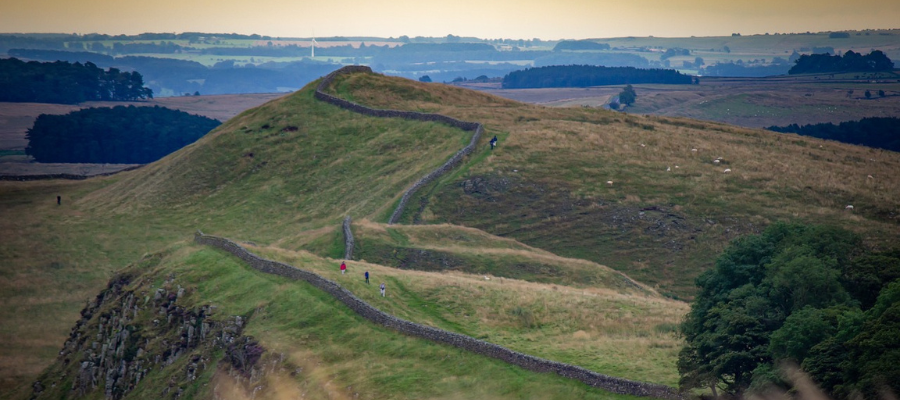
Running 73-miles long with 16 forts, several Roman settlements, and an assortment of immersive Roman Britain museums, a Hadrian’s Wall itinerary could be an entire article in its own right. This UNESCO site saw more than 750,000 people visit attractions its impressive large-scale, long-lasting construction in 2024. This Roman undertaking was built under orders of Emperor Hadrian in AD 122 to “separate the barbarians from the Romans”. Two spots along the wall that give insight into Roman military life are the Corbridge Roman Town and Housesteads Roman Fort.
Corbridge Roman Town
Corbridge Roman Town, originally Coria, was a Roman garrison town. Visitors today will see the foundations of old granaries, markets, workshops, temples, and a fountain house. This location was home to the Romans from the late 2nd century to the end of Roman Britain in the 5th century. This site is most remarkable for the Corbridge Hoard on display at the on-site museum. The hoard is “one of the most remarkable Roman finds of the past century,” according to the English Heritage. It has majorly contributed to historians’ knowledge of Roman armour.
Housesteads Roman Fort
Of the sixteen forts along Hadrian’s Wall, the Housesteads Fort is the best preserved. This garrison housed 800 men at its height. Visible foundational remains include that of a commanding officer’s house, a bath house, barracks, granaries, a storehouse, a hospital, and a headquarters building. There’s significant evidence of an expansion beyond the fortress walls with settlements just beyond the gates. Civilians and tradespeople made this annexed area their new home in Britannia.
Vindolanda Auxiliary Fort and Britain’s Oldest Written Documents
5 hours 30 minutes
Vindolanda predates Hadrian’s Wall by over 35 years but was later incorporated into the wall’s defenses. Each time a new garrison arrived, they would knock down the existing buildings and rebuild to better fit their needs. This means that there were at least nine iterations of Vindolanda! At its smallest, 500 men lived here whereas at its busiest it held up to 1,000. Only 27% of this working site has been subject to excavation, meaning there is a lot more to uncover! So, each time you visit, there will be new artefacts to discover. The most outstanding artefacts are the Vindolanda writing tablets—the oldest handwritten documents in Great Britain.
Carpe Diem!
Get ready to seize the day and visit the best Roman ruins in the UK. Whether you want to visit museums of rare artefacts, walk in the footsteps of Roman soldiers, or enjoy gorgeous ancient mosaics, these sites are the best of the best.
Need a chariot to get you to ancient Britannia Romana? Check out our fleet of cars, vans and minibuses.
Be sure to send us photos of your favourite Roman ruins in the UK on X (Twitter), Facebook, LinkedIn or Instagram!